
What are you reading these days?
Some years ago, I began keeping a list of books I read. It was a tiring process that always ended up lacking complete information and dates (which really means, I was lazy and undisciplined).
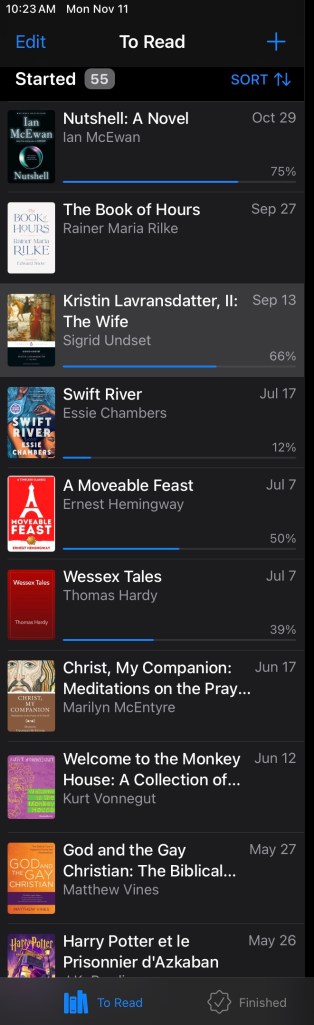
Technology has made the task easier. Choosing among many options, I downloaded an app called “Reading List” that keeps track of books I want to read, have begun, and have finished. They can be scanned in by their barcode or entered manually. By magic, a summary of the book, along with publication information, appears. Entries can be sorted into lists I determine—types of literature, author, language, topic, purpose for reading, etc.
My reading over the years has shifted to mostly fiction. So far this year, mysteries win. (Actually, mysteries are having a good decade.)
My fiction reading list contains literature of breathtaking beauty, the kind of which you stop and say, “Damn, how did that thought ever come into a human brain and why wasn’t it my brain?” (Ian McEwan, Ernest Hemingway, T. S. Eliot, Claire Keegan, Anthony Doerr, Jhumpa Lahiri, Malcolm Guite, Flannery O’Connor, Colm Toibin). I need that kind of reading.
The list contains books whose characters hash out their faith through faulty relationships, miserable circumstances, and the general smacking around by God that leads to coherence and grace if we but pay attention (Susan Howatch, Sigrid Undset, Charles Williams, Frederick Buechner, Flannery O’Connor, Leif Enger, Alice McDermott, Rumer Godden, Jim Crace). I need that kind of reading.
The list contains romps. Good writing with quirky ideas or imaginative stories that pull this reader into the lives of some people I will never meet again but am unlikely to forget (Balli Kaur Jaswal’s Punjabi widows, J. K. Rowling’s witches and wizards, Ismail Kadare’s besieging army of Ottomans and besieged fortress of Christians, Jean Merrill’s General Anna and Frank the Flower, Celeste Ng’s Pearl Warren, Dean Koontz’s Odd Thomas).
Of the many mysteries, there are some repeat offenders: Agatha Christie, Tony Hillerman’s Joe Leaphorn, Laurie King’s Sherlock and Russell, Peter Tremayne’s Sister Fidelma, Colin Dexter’s Morse, Ellis Peters’s Brother Cadfael, Louise Penny’s Armand Gamache, Jacqueline Winspear’s Maisie Dobbs. I crave that type of reading—clever, often historical travelogues highlighting human frailty and the victory of dogged thinking.
My all-time favorite book combines great writing, well-developed characters, theological intrigue, a journey through history, and a humdinger of a mystery set in 17th century Oxford (add ten points): An Instance of the Fingerpost by Ian Pears.
What’s on your list?


Leave a Reply