
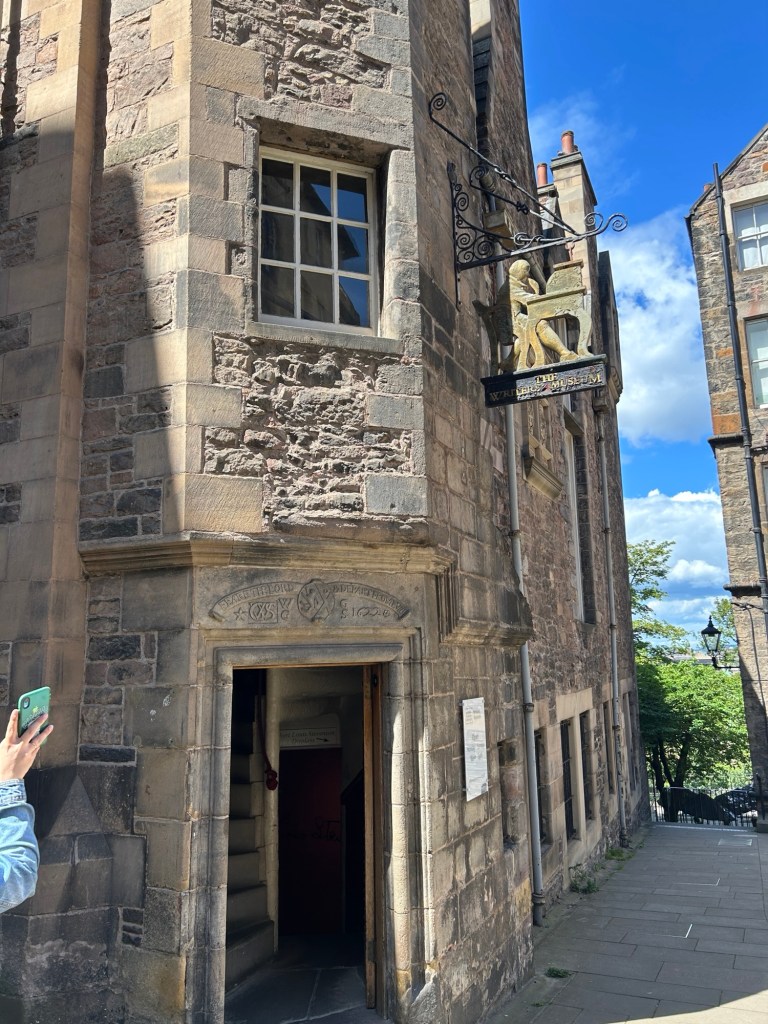
On a corner in a winding walk in the old town portion of Edinburgh stands a 17th century home, now a museum dedicated to the three most Scottish of writers, Robert Burns, Sir Walter Scott, and Robert Louis Stevenson. A narrow, steep staircase connects three floors of exhibits containing personal items of the authors, pictures, writing samples, and a printing press, first editions, and even Sir Walter Scott’s rocking horse. Not being a connoisseur of his writing or career, I wasn’t aware of Stevenson’s deep affection for the Pacific islands. He died in Samoa, far from the gray skies and gray buildings of Edinburgh.
Stevenson’s most famous work, Treasure Island, bears memorable and archetypal characters in literature: The mysterious captain with his yo-ho-ho-ing and insatiable appetite for rum and tall tales of wicked men, heaving seas, black spots, and fearful pirates sets the stage for a first-rate adventure story told through the eyes of a young boy. Jim Hawkins is taken off to look for treasure, discover a marooned sailor, negotiate sailor vs. pirate relations and bad-pirate vs. even-worse-pirate relations, and try to exemplify honesty, bravery, and common sense in a world that cannot be trusted.
(Jim reminds me a bit of Bilbo Baggins and Frodo. The island might have had a Smaug character guarding the treasure, opening a wormhole to Middle Earth. Pirates, orcs, and dwarves–might there be a book in that?)
And then there is the knight Ivanhoe, Rowena, Robin of Locksley (alias, Hood), the Black Knight (alias King Richard), evil King John, comedic yet brave Friar Tuck, the beautiful and skilled Rebecca, Isaac of York, and all the swashbuckling Normans and Saxons who fill Sir Walter Scott’s pages with enough action and chivalry for generations of film-makers to bring the story to the silver screen.
Robert Burns–poet, lyricist, farmer, speaker of his mind, and no friend of Calvin or government–loved the language and folklore of his people and wrote in the dialect he heard all around him. “A Red, Red Rose,” “Auld Lang Syne,” “A Man’s a Man for A’ That” –poems of a man of intelligence, deep emotion, and belief in the humble life as a full and worthy life.
The museum is well worth the visit. Add in more time to read the dozens of engraved slates in the courtyard outside the museum, each bearing a quote from yet more Scottish writers.
Some questions I brought home are, who are my characters? What struggles do they have? Who opposes them? How do they make decisions? What do they value? How do they express themselves? Are they memorable, and why?
I assume there will never be a museum dedicated to their honor, but I can hope (and write) for the best!
Here’s to our characters! Long may they live on the page and in our hearts.

 Ernestly Speaking
Leave a comment